

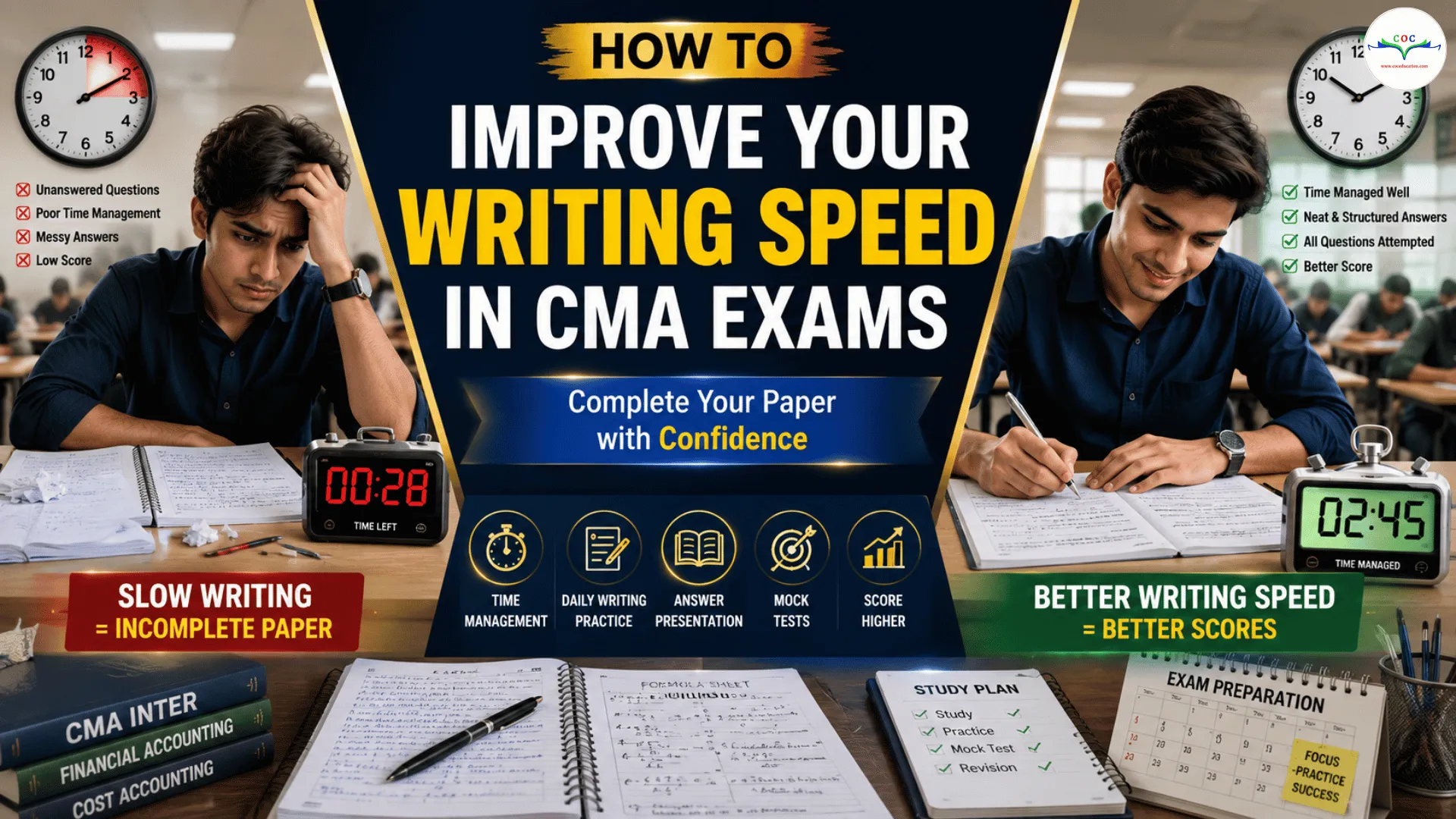
How to Improve Writing Speed in CMA Exams
Introduction
For many CMA students, completing the exam paper on time is just as challenging as knowing the answers. Even well-prepared students often leave questions unanswered because their writing speed is too slow.
In CMA exams, time management and presentation are just as important as subject knowledge. Writing faster doesn't mean writing carelessly—it means expressing your knowledge clearly, efficiently, and within the allotted time.
In this blog, we'll discuss practical strategies to improve your writing speed without compromising accuracy, helping you maximize your marks in the CMA examination.
Why Writing Speed Matters in CMA Exams
CMA exams are designed to test both your conceptual understanding and your ability to apply knowledge under time pressure.
A good writing speed helps you:
- Attempt the entire question paper
- Score more marks by answering additional questions
- Reduce last-minute stress
- Present answers confidently
- Improve overall exam performance
Remember, an unanswered question always scores zero, even if you know the answer.
Understand the Exam Pattern
Before improving your speed, understand:
- Number of questions
- Marks per question
- Time available
- Average time per mark
For example:
- 100 Marks
- 180 Minutes
This gives you approximately 1.8 minutes per mark.
Plan your writing speed accordingly.
Practice Writing Every Day
Reading alone is not enough.
Spend 30–45 minutes daily writing:
- Theory answers
- Practical problems
- Journal entries
- Cost sheets
- Working notes
Daily writing strengthens muscle memory and increases speed naturally.
Solve Previous Year Papers
Previous year question papers provide the best practice.
Benefits include:
- Familiarity with question patterns
- Better time management
- Faster thinking
- Improved confidence
Set a timer and attempt papers under actual exam conditions.
Write Mock Tests Regularly
Mock tests help you simulate the real exam.
During every mock test:
- Follow the official time limit
- Avoid unnecessary breaks
- Use only approved stationery
- Complete the paper within time
After each test, evaluate:
- Which questions consumed extra time?
- Was handwriting slowing you down?
- Could your presentation be improved?
Improve Your Handwriting
Neat handwriting does not have to be beautiful—it simply needs to be readable.
Tips:
- Hold the pen comfortably
- Avoid excessive pressure
- Maintain consistent letter size
- Keep proper spacing
- Write confidently without hesitation
Good handwriting also reduces examiner fatigue.
Think Before You Write
Many students waste time because they start writing without planning.
Instead:
- Read the question carefully.
- Identify keywords.
- Recall the answer structure.
- Then begin writing.
Planning for 20–30 seconds can save several minutes.
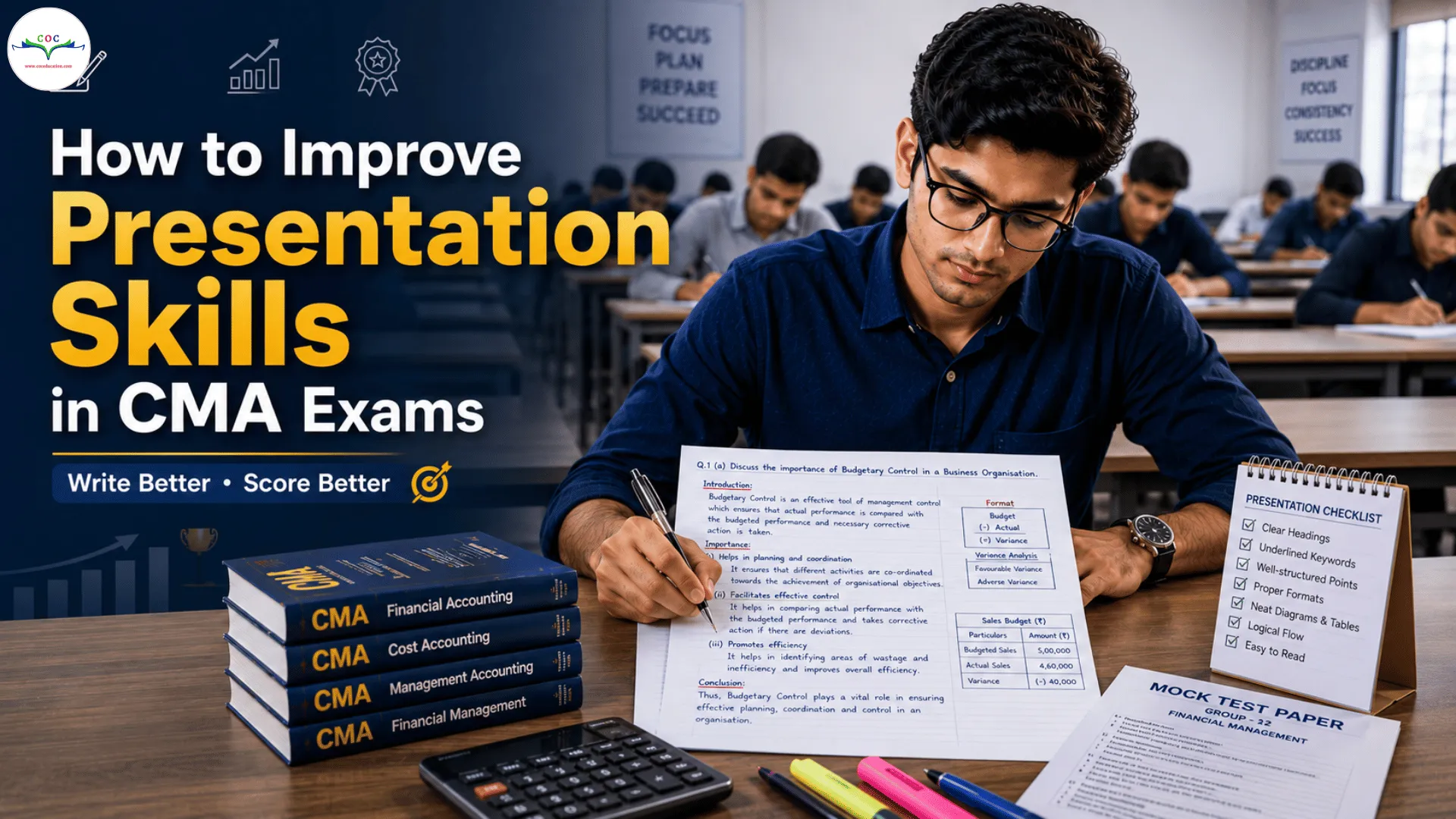
Learn Answer Presentation
Well-structured answers are quicker to write and easier to evaluate.
Use:
- Headings
- Subheadings
- Bullet points
- Numbering
- Tables where applicable
- Underlining important terms
Avoid writing long paragraphs when concise points will do.
Avoid Overwriting
One of the biggest mistakes students make is writing everything they know.
Instead:
- Answer exactly what is asked.
- Stick to the marks allotted.
- Avoid unnecessary explanations.
Writing more than required wastes valuable exam time.
Memorize Key Formats
Many CMA papers require standard formats such as:
- Cost Sheets
- Budgets
- Financial Statements
- Journal Entries
- Reconciliation Statements
- Ratio Analysis
Practice these formats until they become second nature.
The faster you recall them, the quicker you can complete practical questions.
Improve Calculation Speed
For numerical papers:
Practice:
- Mental calculations
- Percentage calculations
- Ratios
- Costing formulas
- Financial formulas
Faster calculations reduce overall writing time.
Time Yourself While Studying
While solving questions:
- Set a stopwatch.
- Allocate time according to marks.
- Stop immediately when time is over.
This builds discipline and improves your speed gradually.
Build Writing Stamina
Writing continuously for three hours requires endurance.
Practice by:
- Writing longer answers
- Completing full-length mock papers
- Avoiding frequent pauses
Your hand muscles will gradually adapt to the exam duration.
Stay Calm During the Exam
Stress often slows writing speed.
Before the exam:
- Sleep well
- Eat light
- Reach the center early
- Read instructions carefully
During the exam:
- Don't panic if one question takes longer.
- Move to the next question if necessary.
- Return later if time permits.
A calm mind writes faster than an anxious one.
Common Mistakes That Reduce Writing Speed
Avoid these habits:
- Spending too much time on one question
- Writing unnecessary content
- Poor answer planning
- Untidy handwriting
- Frequent erasing or overwriting
- Ignoring time limits during practice
- Not attempting mock tests
Correcting these mistakes can significantly improve your exam performance.