

How to Revise Practical Subjects Faster
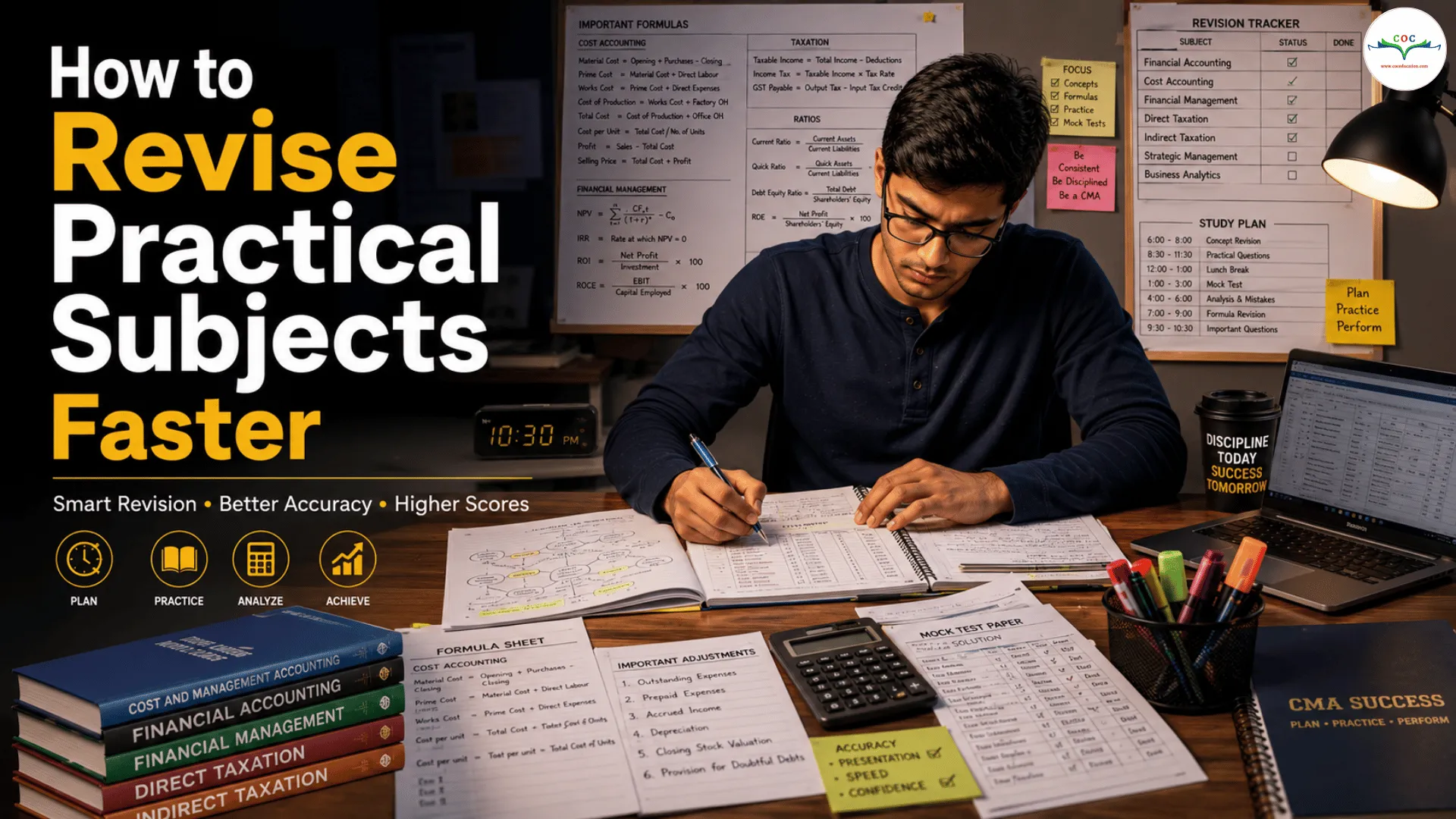
How to Revise Practical Subjects Faster
Practical subjects are often the most scoring subjects in CMA and CA examinations. However, many students struggle to revise them effectively because they involve formulas, calculations, formats, and problem-solving techniques. As exams approach, students often feel overwhelmed by the volume of practical questions they need to revise.
The good news is that practical subjects can be revised much faster than theory subjects if you follow the right strategy. In this blog, we'll discuss proven techniques that can help CMA and CA students revise practical subjects quickly and efficiently.
Why Practical Subject Revision Is Different
Unlike theory subjects, practical subjects focus on application rather than memorization.
Practical Subjects Typically Include
Financial Accounting
Cost and Management Accounting
Financial Management
Direct Taxation
Indirect Taxation
Strategic Financial Management
Business Analytics
Advanced Financial Reporting
Success in these subjects depends on understanding concepts and practicing problem-solving methods.
Focus on Concepts Before Questions
Many students jump directly into solving questions without revising the underlying concepts.
What You Should Do First
Revise formulas
Understand key concepts
Review important formats
Revisit common adjustments
Once concepts are clear, solving questions becomes much faster and easier.
Create Formula and Summary Sheets
One of the best ways to revise practical subjects quickly is by maintaining separate formula sheets.
Include
Important formulas
Ratios
Tax rates
Costing formulas
Financial management formulas
Key accounting adjustments
A well-prepared formula sheet can save hours during revision.
Follow the Question Pattern Method
Most practical questions follow a similar structure.
Instead of Revising Every Question
Focus on:
Question format
Solution approach
Important adjustments
Presentation style
Once you understand the pattern, multiple questions can be solved using the same logic.
Practice Important Questions Repeatedly
Quality matters more than quantity.
Prioritize
RTP questions
MTP questions
Previous year questions
Frequently asked concepts
Important case studies
Solving important questions multiple times improves speed and accuracy.
Use the 80/20 Rule
Not all chapters contribute equally to exam scores.
Focus First On
High-weightage chapters
Frequently tested topics
Scoring areas
Practical concepts with recurring questions
This strategy maximizes marks while minimizing revision time.
Prepare Chapter-Wise Revision Notes
Create short notes for every practical chapter.
Include
Important formulas
Common mistakes
Key concepts
Working note formats
Shortcut techniques
These notes become extremely useful during the final week before exams.
Learn Standard Formats
Many practical subjects contain standard presentation formats.
Examples
Cash Flow Statement
Cost Sheet
Financial Statements
Budgeting Formats
Tax Computation Formats
Once you master these formats, solving questions becomes significantly faster.
Revise Working Notes Carefully
In practical papers, working notes often carry significant marks.
Focus On
Adjustment calculations
Supporting workings
Formula applications
Presentation methods
Many students lose marks because of weak working notes rather than incorrect concepts.
Practice Under Time Limits
Knowing the solution is different from writing it in the examination hall.
Benefits of Timed Practice
Improves speed
Enhances accuracy
Reduces exam pressure
Develops time management skills
Try solving at least one mock paper within the actual exam time limit.
Use Mistake Analysis Sheets
Every student makes mistakes during practice.
Maintain a Notebook For
Calculation errors
Conceptual mistakes
Presentation mistakes
Frequently forgotten formulas
Reviewing mistakes prevents repetition in the actual examination.
Revise Through Question Classification
Group questions according to their difficulty level.
Categories
Easy Questions
Revise one day before the exam.
Medium Questions
Practice regularly during revision.
Difficult Questions
Focus on concepts and understand the approach.
This classification improves revision efficiency.
Watch Fast Revision Sessions
Revision lectures can be helpful during the final stages of preparation.
Use Them For
Quick concept refreshers
Formula revision
Exam-oriented guidance
Last-minute preparation
However, avoid relying solely on videos. Active problem-solving is essential.
Common Mistakes Students Make
Avoid These Errors
Reading solutions without solving
Recent Posts